

We understand that deep-sea nodule collection raises important questions. For people who care about our responsibility to planet and about their investment in TMC, it’s crucial to know that we’ve partnered with some of the world’s best scientific research organizations to do the science — and the results are in.
After over a decade of research, 22 offshore campaigns, and extensively monitored pilot mining trials, we’ve compiled one of the largest ever deep-sea environmental datasets as part of our Environmental and Social Impact Assessment. This dataset, covering findings from our NORI-D exploration area up to January 2022, includes an unprecedented 32,617 benthic and 42,036 pelagic biological occurrences, world-first MOCNESS net samples of micronekton at 4,000-meter depths, over 12,000 seafloor images, and several years of continuous oceanographic monitoring data from moorings.
Here’s how we’re using our data to tackle the six most common concerns raised about deep-sea mining — and why the facts may surprise you.
1. Seafloor Plumes: how far do they really travel?
The concern: Sediment clouds generated by the collector vehicle could smother ecosystems over thousands of kilometers.
What we found: Our test mining data — which align with those of MIT — show that over 95% of the sediment stirred up by the collector resettles within just 1-2 km, because at these depths sediment particles stick together, settling rapidly.
We deployed over 50 monitoring assets in the water column and on the seafloor to measure how far the plume spread during test mining, including Remotely Operated Vehicles (ROVs), Autonomous Underwater Vehicles (AUVs), and seafloor landers. These assets were used to measure and document how much sediment was mobilized by the collector vehicle, and where it settled. This intensive 6-month-long study was conducted in partnership with 18 leading marine research institutions and contractors from around the world.
The myth: Dense plumes drifting endlessly across the ocean.
The fact: Real-world data shows localized impact within, and immediately adjacent to, the directly mined area. Watch the video below to learn more.
Resources:
Watch our pilot plume monitoring in action
Carlos Muñoz-Royo et al., An in situ study of abyssal turbidity-current sediment plumes generated by a deep seabed polymetallic nodule mining preprototype collector vehicle. Sci. Adv. Vol. 8, 38 (2022).
Peacock, T. The GSR Patania II Expedition: Technical Achievements & Scientific Learnings. Global Seabed Mineral Resources (2023).
The Metals Company. TMC Subsidiary NORI Shares Preliminary Findings on Environmental Impacts of Pilot Nodule Collection System Test (2023).
Polymetallic Nodule Research Alliance. Will deep-sea mineral extraction create sediment plumes? (2025).


Test mining data shows the plume stays low and settles fast, with areas most impacted by sediment limited to just a few hundred meters.
2. Midwater Plumes: will they impact fisheries?
The concern: The return water, which contains a small amount of sediment and nodule particles, is piped back into the ocean and could contaminate the food chain, harming tuna and other commercial species.
What we found: Based on our research and in consultation with scientists, we have chose to purposefully return the water at 2,000 meters, much deeper than where tuna and mammals typically live or dive for feeding. During our trials, we found that when we returned this seawater-sediment mixture back into the water column, it created a shallow pancake where sediment concentrations were above the natural range of variation. At 150 meters deep, this pancake showed little vertical movement and, as it spread out horizontally, sediment concentrations diluted to background levels within tens of kilometers and within 2-4 days. Dilution occurs so quickly because of the relatively small amount of sediment the return water contains compared to the vast volume of seawater it is released into, and mixing is accelerated by the continuous horizontal and vertical movement of the riser pipe as our vessel moves forward.
Our test mining models also show that dissolved metals in the plume dilute to ocean background levels within several kilometers, with concentrations that could potentially cause an impact to passing pelagic organisms isolated to a very small volume of water immediately surrounding the outlet of our constantly-moving riser pipe. Importantly, scientific studies from the CCZ confirm that the ocean already contains abundant natural organic molecules that bind up trace metals in forms that marine life cannot absorb, such that any remaining free-ion concentrations are well below harmful levels. Once the plume is diluted, the dissolved metals present no realistic risk to ocean ecosystems.
While test mining campaigns in the 1970s could only rely upon rudimentary methods to monitor the midwater plume, major advancements in subsea robotics and sensors made it possible for the independent academics and engineers we partnered with to image the mid-water plumes and measure its contents.
The myth: Midwater plumes could impact vast volumes of water and poison fisheries.
The fact: The sheer scale of the ocean means sediment concentrations in commercial-scale midwater plumes dilute rapidly within a few kilometers, while trace metal concentrations dilute quickly to background levels and are bound in forms that can’t be absorbed by marine life. It’s also important to acknowledge our partner Allseas, whose engineering has ensured that nearly all sediment remains on the seafloor — thanks to a highly efficient nodule pickup and transport system that brings only a small amount of sediment up the riser.
Resources:
Polymetallic Nodule Research Alliance. Will deep-sea mineral extraction disrupt fishing? (2025).
International Seabed Authority. Technical Study 33: Potential interactions between fishing and mineral resource-related activities in areas beyond national jurisdiction – a spatial analysis (2023).
New Zealand National Institute of Water and Atmospheric Research (NIWA). Assessment of the potential impacts of deep seabed mining on fisheries (2016).


Test mining data has been used to validate a commercial-scale model showing midwater plumes dilute rapidly and are all but undetectable after a few kilometers.

3. Noise & Light: are we disturbing marine life?
The concern: Noise and artificial light from mining may disrupt marine ecosystems.
What we found: The primary noise source is the surface vessel, and acoustic monitoring of our pilot production system during test mining revealed that sound levels which could cause behavioral change in mammals are constrained to a radius equivalent to other regulated marine industries. Similarly, light is limited — seafloor lighting is constrained to a cone radiating just tens of meters outwards from the collector, and surface light from the ship penetrates just a couple of hundred meters into the surface water layers.
The myth: Noise and light pollution will harm creatures and their ability to communicate.
The fact: We measured our operational noise footprint and found that noise levels above NOAA-designated thresholds deemed to have an impact on mammal behavior are constrained to within several kilometers of our production vessel. This noise is primarily generated by the vessel’s dynamic positioning thrusters and is comparable to noise from other marine industries. Light will be tightly constrained, both at the seafloor and at the surface.
Resources:
Polymetallic Nodule Research Alliance. Will deep-sea mineral extraction affect ocean noise? (2025).
Polymetallic Nodule Research Alliance. Will deep-sea mineral extraction affect cetaceans in the ocean? (2025).


4. Carbon Sequestration: are we impacting the oceanic carbon sink?
The concern: Stirring up seafloor sediments during mining could release stored carbon into the atmosphere.
What we found: To start, seafloor sediments store less than 5% of all oceanic carbon, a minuscule fraction of which is found on abyssal plains. Importantly, the tiny amount of carbon that they do contain cannot be converted by microbes into carbon dioxide because it is not available for their consumption. Resuspended particles settle quickly as we have demonstrated through our in-field testing, and there’s no known pathway for sediment-stored carbon to reach the surface 4 kilometers above within any meaningful timescale.
MIT Professor Thomas Peacock, when speaking about deep-sea mining’s potential impact on the oceanic carbon sink during his testimony to Congress in April 2025, said “it was established in about 2020 that this is not an issue”, referring to a peer-reviewed paper.
The myth: Deep-sea mining could impact the ocean’s ability to sequester carbon and accelerate climate change.
The fact: Our activities, even at scale, will not materially impact the carbon cycle, even if we tried. In fact, we believe that by contributing far-less carbon intensive metals to support the energy transition and the creation of a circular metals supply chain, that our metals can play an important role in planetary decarbonization.
Resources:
Orcutt, B. N., et al. Impacts of deep-sea mining on microbial ecosystem services. Limnology and Oceanography 65: 1489–1510 (2020).
Friedlingstein et al. Global Carbon Budget 2023. Earth Syst. Sci. Data, 15, 5301–5369 (2023).
ISA Fact Check: The Carbon Cycle in the Area
Polymetallic Nodule Research Alliance. Will deep-sea mineral extraction release carbon into the atmosphere? (2025).


5. Biodiversity Loss: are we endangering unknown species?
The concern: Collecting nodules on the abyssal plain might lead to extinction of species that haven’t been studied.
What we found: After over a decade of research, we’ve developed a comprehensive environmental baseline of the NORI area from seafloor to surface, making this area one of the most well documented deep-sea regions on the planet. Positive signs of recovery have also been observed from multiple mining tests. The latest study, published by researchers from Natural History Museum London and MIT in 2025, observed full recovery of microscopic organisms in both track and plume areas, 44 years after they were disturbed by far more impactful equipment than is planned for use today. Our system has already demonstrated a much lower impact footprint than earlier tests, and we’ve documented faster recovery rates for similar microscopic organisms—reaching 30% of pre-disturbance density and 50% of diversity within just one year. These ecosystems have the ability to recover.
The vast nodule fields of the Clarion Clipperton Zone offer significant opportunities for protection: half of the area has already been set aside, never to be mined, and we will designate further large ‘no-take zones.’ Observations a year after test mining show nodules left behind quickly lose their sediment cover, making them available as habitat again as organisms rework the sediments and expose them. Research shows that the nodule abundance is not the limiting factor for deep-sea biodiversity, and that if we leave at least 5% of nodule coverage then we can facilitate or even speed up recovery. In total, at least half of the nodules in our license areas will remain untouched.
The myth: We’re flying blind and could destroy lots of life that we don’t understand.
The fact: We’ve built the largest biological baseline in the CCZ which gives us a high-resolution understanding of what lives down there, down to the microbial level. Just as on land, we are unlikely to document all organisms, and extensive protected zones and the mosaic of areas that will be left untouched will help to prevent significant loss of biodiversity on the massive abyssal plains of the Pacific Ocean.
Resources:
Explore TMC’s environmental data Simon‐Lledó, Erik, et al. Ecology of a Polymetallic Nodule Occurrence Gradient: Implications for Deep‐Sea Mining. Limnology and Oceanography, vol. 64, no. 5, 13 (2019).

6. Habitat Destruction: will the impact be permanent?
The concern: Mining might irreversibly destroy ancient habitats.
What we found: The abyssal CCZ plays host to various habitat types, ranging from areas with high and low density of nodules. TMC’s activities will leave a patchwork of nodules behind, causing a change from one type of habitat to another.
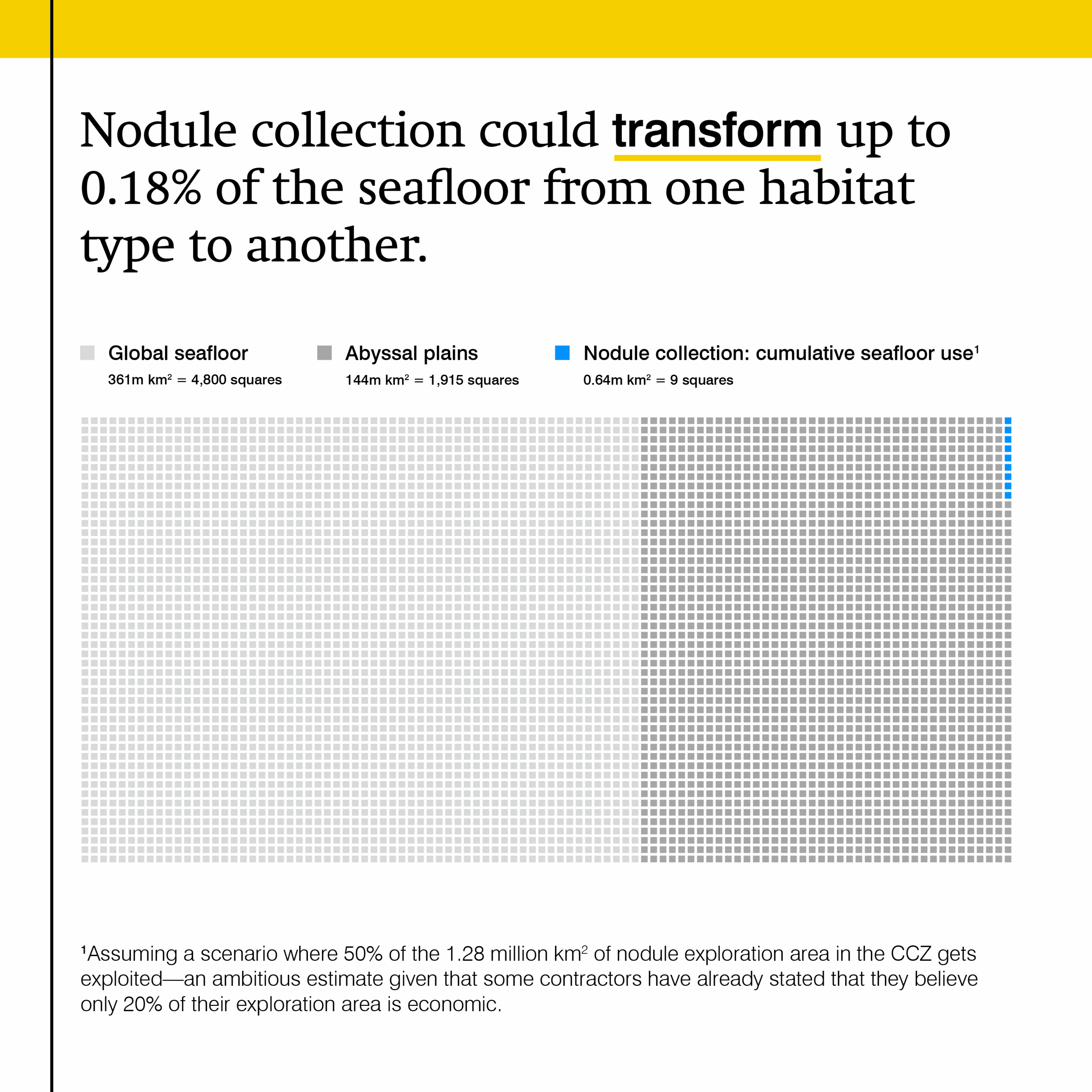
Consider this: Even if we assume that 50% of all exploration contract areas awarded by the International Seabed Authority moved into production tomorrow, nodule collection would transform just 0.18% of the global seafloor from one very common habitat to another.
Importantly, at least 43% of the entire CCZ is already protected from any mining, ensuring the abyssal plain ecosystem will be protected. Thanks to re-visits to 1970s test mining sites as well as data from our own trials, we know that the ecosystem recovers.
The myth: Deep-sea mining is a one-way ticket to deep-sea ecosystem destruction.
The fact: Impacts are minimal and manageable — nodule collection will simply change parts of seafloor from one habitat type to another, and studies show that ecosystems do recover from nodule collection. By protecting large areas of the CCZ and ensuring our impact is as minimal as possible we can help ensure that this deep-sea habitat is not destroyed.
Resources:
The Metals Company. How Much Seafloor Will the Nodule Collection Industry Impact?, The Metals Company (2022).
Jones, Daniel, et al. Long-Term Impact and Biological Recovery in a Deep-Sea Mining Track. Nature, 642, pages 112–118 (2025).
Vonnahme, T. R., et al. Effects of a Deep-Sea Mining Experiment on Seafloor Microbial Communities and Functions after 26 Years. Science Advances, vol. 6, no. 18 (2020).
Protected areas in the Clarion Clipperton Zone.

What you can do
We believe in open science and informed discussion. Here’s how you can get involved:
- Share the facts: Use our videos, in-field studies, and modeling data in social conversations
- Fact-check myths: Refer people to in-field data and peer-reviewed studies conducted on actual deep-sea operations
- Stay informed: Sign up for investor updates here
Resources for investors and advocates
- TMC Investor website
- Pilot Collection System Video
- Lifecycle Assessments Comparing Impacts of Sourcing Metals
- Preliminary EIA Findings – Press Release
- The Polymetallic Nodule Research Alliance
Let’s move the conversation forward — with facts.